Key Conclusions from Transform Finance Conference in Frankfurt

L&M PRISK participated in this year’s Transform Finance Conference that took place in Frankfurt on 5 September. The conference revealed three major trends in political risk analysis and management. Firstly, against the backdrop of escalating geopolitical tensions and the global threat of terrorism, political risks for companies and banks are currently increasing massively. Political risk factors and constellations must be considered in their entirety. Secondly, KYC screenings must be carried out thoroughly and comprehensively before signing contracts and onboarding. Software checks alone and superficial checks to just meet legal obligations are no longer sufficient. In fact, this traditional approach is associated with massive risks, today. Thirdly, companies need comprehensive risk analysis and management models. It is no longer enough for individual company departments to simply collect and save data and view risks separately from one another. As panelists emphasized, the work of political risk managers will thus increase significantly and become more interesting in the coming years. Interpretations and comprehensive assessments by experts will be more important than ever before.

At the conference, Hannes met Josephine K. Vanek, CB -Trade Finance & Lending (TF&L) Operations - Embedded Risk Management at Deutsche Bank.
Hannes Meißner
NTV podcast on EU accession, economy and investment in Moldova

On the NTV "Wirtschaft Welt & Weit" podcast, Hannes Meissner discusses Moldova's EU accession prospects and the opportunities and risks for foreign investors in the country with Andrea Sellmann and Ludwig Graf Westarp. How successful is Moldova in terms of rule of law reforms? Will the economic situation improve? What opportunities does the country offer for Austrian and German companies? What is the impact of Russian plans to overthrow the government? Please follow the link to find answers to these and other questions.

Hannes Meißner
Interview with ZEIT Online on Business in Turkmenistan

The war in Ukraine and the sanctions against Russia are having a major impact on European companies. Many are looking for alternative markets, including in Central Asia. At first glance, gas-rich Turkmenistan seems particularly promising, and not just for energy companies. However, as Hannes Meissner emphasizes in the article “'Alles Walzer' in der Wüste” by Simone Brunner in "ZEIT ONLINE", political risks in Turkmenistan are high and require a special management strategy. Here is the link.

Hannes Meißner
NTV Podcast on Moldovan conflict region Transnistria with Hannes Meissner

A war in Molodova is becoming more likely. Following his re-election, Putin is signalling his willingness to further escalate the geopolitical struggle aimed at re-establishing Russian hegemony in the entire post-Soviet space. For the time being, however, Moscow will continue to rely on hybrid warfare in an attempt to further destabilise the situation in Moldova in order to undermine Moldova's EU rapprochement process. There is no sign of any willingness to compromise. The sole aim is a pro-Russian change of government. Transnistria is a decisive lever here. While the local political and business elite in the separatist region has no interest in this, the decision lies solely with Moscow.
Please listen to the new podcast on Transnistria with Kevin Schulte from NTV.

Hannes Meißner
New service by L&M PRISK: Business Briefs – First brief on Rising Nationalization Risk in Russia

Drawing on our deep insights and confidential sources, our business briefs provide macropolitical risk analysis and strategy recommendations on current topics. The aim is to provide our customers with a quick guide to current events and trends in post-Soviet countries and their implications for business. The business briefs are free of charge, but access requires registration.

Our first business brief covers the topic that European companies face a rising risk of nationalization in Russia, as our independent and confidential resources from the region report. While the EU takes steps towards confiscation of Russian assets, Europe can expect an equally effective counter-response, in line with the strategy of symmetric retaliation proclaimed by the Kremlin.

Please follow this link to our new service and the policy brief “European Companies’ Risk of Nationalization Rises Substantially”.

Hannes Meißner
Insights into Tadjikistan

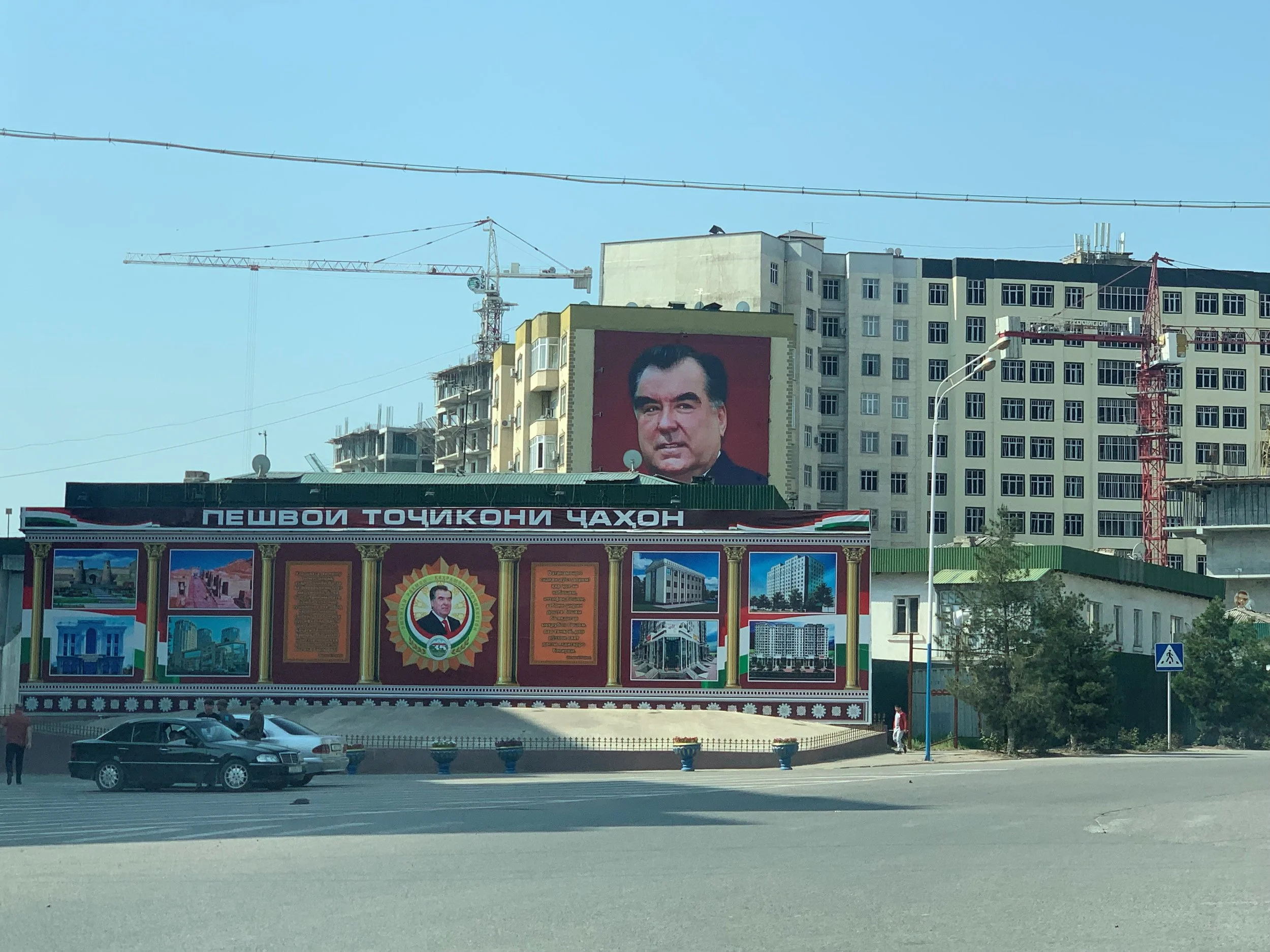
Four key impressions remain from a personal trip to Dushanbe, the capital city of Tajikistan. In recent years Tadjikistan has become one of the most authoritarian states in the world.

Firstly, President Emomalij Rahmon is omnipresent through his personality cult. His portraits and slogans can be found on buildings and bridge overpasses in the capital and the surrounding area, as well as on large posters along the main roads.

Secondly, Dushanbe is being de facto reinvented in the course of a gigantic construction boom. The Soviet city has largely given way to new high-rise buildings. An urban middle class is present in the main streets of the city. This contrasts with the situation in the rest of the country, which remains economically weak and characterized by socio-economic problems.

Thirdly, the country appears to benefit comparatively little from the opening up of new trade routes as a consequence of the New Silk Road and the sanctions against Russia, as it is landlocked and not a member of the Eurasian Economic Union.

Fourthly, the country's business community is concerned about the EU's idea of confiscating Russian assets. They are openly asking whether the EU is sacrificing legal certainty for political goals and whether property is still safe in the EU.

Portratis of Rahmon in Hissor

Portraits and slogans along a main road

Hannes Meißner
Virtual Event - Geopolitics is back in Europe: Russia, EU, and its impact on European companies

The virtual event hosted by LM Political Risk and Strategy Advisory together with “Altstipendiaten der Konrad-Adenauer-Stiftung e.V.” and its special interest network "Netzwerk Aussenwirtschaft", delved into the pressing topic of "Geopolitics is back in Europe: Russia, EU, and its impact on European companies." We would like to thank the numerous participants whose insightful questions enriched the discussion. Johannes Leitner and Dr. Laetitia Spetschinsky (OIIP & University of Leuven) discussed the impact of Russia’s war in Ukraine and EU’s sanctions strategy on businesses in Europe.

In conclusion, it is essential for business leaders to heed the following key points:

⚡ The global trade framework faces significant challenges and is undergoing transformation.

⚡ Geopolitics is making national security a priority.

⚡ In response to Russia's invasion of Ukraine, the EU has quickly adapted to the application of sanctions, signaling a paradigm shift.

⚡ Sanctions have become a permanent state of affairs and are becoming an increasingly popular diplomatic instrument.

⚡ The risk of expropriation in Russia for Western companies is on the rise and requires careful attention.

These insights underscore the critical need for proactive strategic planning and risk management strategies in navigating the evolving geopolitical landscape, safeguarding the interests of European companies amidst geopolitical uncertainties.

Hannes Meißner
NTV Podcast on Moldovan conflict region Gagauzia with Hannes Meissner

Strengthened by his re-election, Putin is announcing increased steps to re-establish hegemony in the post-Soviet space. Further escalation seems inevitable, not only in Ukraine, but also in Moldova. This means that another war is becoming more likely, at the end of this year at the earliest. Until then, Russia’s primary strategy remains focused on overthrowing the pro-European government of Maia Sandu by means of hybrid destabilization strategies. Transnistria remains a decisive lever for Moscow. But with Gagauzia, another conflict is now coming into the spotlight. Please listen to my podcast on Gagauzia with Kevin Schulte from NTV. Here is the link.

GeneralHannes Meißner
Hannes Meissner as a guest on the radio program Ö1 Punkt eins on the situation in Nagorno-Karabakh

In early summer, the peace negotiations on Nagorno-Karabakh seemed to be close to a major breakthrough. Since then, however, the conflict positions have hardly shifted. Even more, the blockade of the Lachin corridor by Azerbaijan and the prevention of aid transports from Azerbaijan by the local government have led to a humanitarian catastrophe in the isolated region. On September 11, Hannes discussed the roots of the conflict, the geopolitical constellation in the region, and the propsects for peace with Barbara Zeithammer (Ö1 moderator), including questions from the audience. Please follow the link to the radio discussion.

Hannes Meißner
L&M PRISK Keynote at the 13th Annual Conference on Business Ethics & Anti-Corruption Compliance in CEE & SEE

Dr. Johannes Leitner will give a keynote speech on Market Entry Due Diligence and Sanctions Management at the 13th annual conference on BUSINESS ETHICS ANTI-CORRUPTION COMPLIANCE & FRAUD PREVENTION STRATEGIES IN CEE. The conference will take place in Prague on 21 Septemer. He will moreover contribute to the panel discussion on the current status of the sanctions regime and its impact on corporate activities. Please see the programme for more information on the conference.

Hannes Meißner
Effects of political strategies on corporate decisions - Key Note Speech at the Economic Council

Dr. Johannes Leitner was invited to to the Federal Commission for International Affairs of the Wirtschaftsrat (Economic Council) in Berlin, where he gave a speech on the "Effects of political strategies on corporate decisions".

As Johannes pointed out, we are currently in a process of slight deglobalisation. Unlike in the past, international relations are no longer primarliy dominated by business and trade interests. The driving factor is rather the primacy of politics. In fact, this is not an entirely new phenomenon. Such trends have been observable for more then ten years now. Economic rationality is increasingly giving way to political goals. This means that more then ever before, chances for companies have to be examined on the basis of geopolitical risk constellations. An example of this are trade policy interventions in the relationship between the USA and China, reducing economic interdependencies. In this context again, the main features of this China strategy reach far back to the term of office of George W. Bush Junior.

Please follow this link to the full content of the keynote speech.

Hannes Meißner
US Student William Menkes Completed Internship at L&M PRISK

From May to July, the L&M PRISK team had an additional member. William Menkes, a student at the University of Colorado, practiced corporate intelligence, KYC, and investigative research.

Hannes: Dear William, thank you very much for your great support during the last weeks. Can you please give us some details on the exchange program, you were part of?

William: I was part of an internship program this summer called IES that connects Americans on university campuses with international internship opportunities and business professionals. Furthermore, I completed two courses on Austrian politics and business in relation to the United States as well as a German Intensive.

Hannes: Why did you decide to come to Vienna?

I choose Vienna because it was important to me to work in a German-speaking city to practice my language. I also study international relations and German with a focus on the post-Soviet space. Vienna of course is somewhat of a political hub in Europe with the UN headquarters lying there. I thought it would be the best option to combine these two interests.

Hannes: What experiences did you make during your internship?

While working for L&M PRISK this summer, I learned about KYC reports and corporate investigation. I gained a glimpse into the process of conducting background reports. I also learned about NGOs through research and how business connections are made. I of course made some good connections with you and Johannes and your team. I also learned about the Austrian work culture and professional businesses in general as this was my first opportunity at working for one.

Hannes: Why do you think political risk consulting is important?

William: I am currently studying international relations due to my interest in European affairs and how it pertains to nations in the EU and post-Soviet space today. I believe political risk consulting is especially important in diverse regions of the world such as Europe today. Experts in the geopolitical landscape of a diverse region such as Europe are a necessity in guiding a business’s professional operations through sanctions, trade, ESG, conflict, etc... Specialists in this field offer a variety of expertise an organisation can use to gain a new self-reflective angle on moving forward with international operations.

Hannes: Thank you, William. We wish you all the best for your future.

Hannes Meißner
The War in Ukraine, the Conflict with Russia and Geopolitical Shifts: Political Risks and Management Options

Special Issue by Johannes Leitner and Hannes Meissner

Johannes Leitner and Hannes Meissner have edited a special issue of the academic journal “Wirtschaft und Management”. It is dedicated to the war in Ukraine, the conflict between the West (EU/USA) and Russia and associated geopolitical shifts at the global level. It sheds light on consequences of this constellation for enterprises and asks how businesses can manage this new situation. The special issue contains contributions by Florence Ertel and Julian Plottka (University of Passau), Oxana Karnaukhova (University of Passau), as well as Albert Hayrapetyan and Susanna Aghajanyan (Armenian State University of Economics). In their own contribution, Hannes Meissner and Johannes Leitner zero in on the dramatic geopolitical changes currently taking place against the backdrop of the Russian attack on Ukraine. They analyse the possible effects on enterprises and provide an outlook on new risk management strategies in ligh of Russia’s strong influence on post-Soviet countries. The edited volume is available at this link.

Hannes Meißner
Schneider Group Business Breakfast - Kazakhstan and Uzbekistan

On 26 June 2023 (09:00-11:30) the Schneider Group holds a business breakfast at Hilton Vienna Park (Stadtpark 1, 1010 Vienna). The event is dedicated to the business environment and HR in Kazakhstan and Uzbekistan, as well as green energy, pharma, agriculture and logistics, and sucess stories and pitfalls.

The following presentations are scheduled:

  1. Kazakhstan and Uzbekistan as the New Eurasian Tiger States with Clemens Machal, Commercial Counsellor & Trade Commissioner of Austria for Kazakhstan, Kyrgyzstan, Tajikistan, Turkmenistan, Uzbekistan

  2. Growth opportunities in Kazakhstan with Kirill Afanasyev, Partner SCHNEIDER GROUP Kazakhstan

  3. HR for market entry and business expansion in Kazakhstan with Olga Nezgovorova, HR Director SCHNEIDER GROUP Kazakhstan

  4. Growth opportunities and HR in Uzbekistan with Nodir Ayupov, Partner SCHNEIDER GROUP Uzbekistan

  5. Between euphoria and regulations: compliance management for Central Asia and the South Caucasus with Dr. Johannes Leitner, Managing Partner, LM-Prisk

  6. Project taxation Central Asia with Andreas Radu, Professional, ICON Wirtschaftstreuhand GmbH

After the presentations, a Q&A session will take place.

For the detailed program, please follow this link. Please register until 26 Juni via this link.

The event will be held in English.

Hannes Meißner
NTV Podcast on Nagorno-Karabakh with Hannes Meissner

In his recent podcast, Kevin Schulte (NTV) analyses the current status of the conflict between Armenia and Azerbaijan over the Nagorno-Karabakh region. For more than a hundred years, Armenia and Azerbaijan have been fighting over the once mixed ethnic region. Currently, a solution to the conflict seems closer than ever - at least on paper. Russia, meanwhile, is trying everything to freeze the conflict again. Hannes Meissner reports from the Armenian capital Yerevan.

Hannes Meißner
Seizing Opportunities, Minimizing Risks: Managing Compliance Risks and Due Diligence Practises in the Post-Soviet Space

Johannes Leitner spoke at DHK Business Breakfast

Central Asia and the South Caucasus are experiencing an economic boom. At the same time, increasingly stringent regulations apply to business activities in the region.Johannes Leitner, expert in the field of political risk management and business strategy, shared insights into opportunitites and risks in the region at the DHK Business Breakfast at DHK's offices in Vienna.

Building on his project experience, Johannes provided details on economic dynamics, regulatory and political risks, and classic compliance challenges and management strategies. "The regulatory environment does not affect every company equally. Retailers face different challenges than a logisticis company or equipment manufacturer," the political risk expert highlighted. However, the fact is - despite geopolitical obstacles and sanctions - there is strong growth in the region, he said.

Johannes further emphasized that the war in Ukraine is going along with geopolitical shifts of global dimension. As a result of this, a return to the pre-war constellation and business as usual is unlikely, even in the long-term.

The post-Soviet region of Central Asia, and here in particular Uzbekistan and Kazakhstan, have recently attracted increased interest from German and Austrian companies, Johannes said. In addition to the opportunities offered by the markets themselves, this is primarily due to the shift in trade flows as a result of the Ukraine war and the sanctions against Russia and Belarus. The establishment of new business partnerships, and the shift of supply and distribution chains are accompanied by compliance challenges that need to be managed against the backdrop of increasingly strict national and international compliance rules, the consultant said.

Johannes Leitner (left) and Thomas Gindele (right), head of the DHK in Austria

Hannes Meißner
Turkmenistan Builds a City That No One Needs

Kevin Schulte (NTV) dedicates his latest podcast to Turkmenistan. Thanks to the high income from the export of natural gas, the ruling elite lives in wealth, while the population is impoverished. The money is systematically wasted on gigantic construction projects and the personality cult around the president. An entire provincial capital is now being dedicated to the former president, which is being built. Hannes Meissner provides the background to the story.

Hannes Meißner
L&M PRISK Expertise for the Vienna Dialogue

On 17 and 18 April, workshops and discussion panels took place within the framework of the "Vienna Dialogue". The event took place in the premises of the WKO. The format is organized by the Konrad Adenauer Foundation (Vienna Office) and the University of Passau. The Vienna Dialogue aims at developing concrete proposals for utilizing the potentials of German-Austrian cooperation in order to inspire European Union (EU) policy by providing innovative ideas.

In the course of the event, L&M PRISK contributed its own expertise to the working group on enlargement policy. In this group, experts with technical and regional expertise discussed European responses to climate change and the conditions for joint initiatives. The experts analyzed the impact of climate change in Southeast Europe, especially on agriculture and tourism. In addition, they developed adequate responses, paying particular attention to processes and reforms that individual states should implement in the field of energy policy. Another focus was put on the question of how to maximize the influence of the European Union in the enlargement process. One conclusion was that state capture and corruption are major problems in the Western Balkan states. Transparent tender processes, the strengthening of the European Public Prosecutor's Office, new institutions and shared sovereignty, as well as innovative and small-scale projects tailored to SMEs could make a significant contribution in the future.

Hannes Meissner (L&M PRISK) during the presentation of the results of the working groups.

Hannes Meißner