The Austrian Institute for International Affairs (OIIP) has gained a new member in January 2026: Managing Partner Dr Johannes Leitner has joined the prestigious institute as an affiliated researcher, due to his expertise on geopolitical risks, global power shifts, the transformation of the international order and the impact of these changes on European companies. In this regard, the goal is to establish synergies between the OIIP and L&M PRISK. Since 1979, the OIIP has been one of Austria's most important independent research institutions, providing in-depth analyses of international politics.
Presentation by Dr Johannes Leitner at the GCM Parker Conference
The annual GCM Parker Conference, held for the 15th time in the Czech capital in October, brought together international company representatives and experts to discuss business ethics, anti-corruption, compliance and fraud prevention strategies in Central and Eastern Europe. Recent research across Europe indicates that companies are increasingly exposed to fraud, corruption and schemes of sanctions circumvention. In addition, the increase in political intervention in trade over the last 5 years has been clearly noticeable. According to Dr Hannes Meissner and Dr Johannes Leitner, a well-developed trade compliance system is an indispensable tool to establish a safe haven for companies in these turbulent times, characterized by geopolitical tensions, hybrid warfare and geopolitical tensions.
The slides from the presentation can be found at this link.
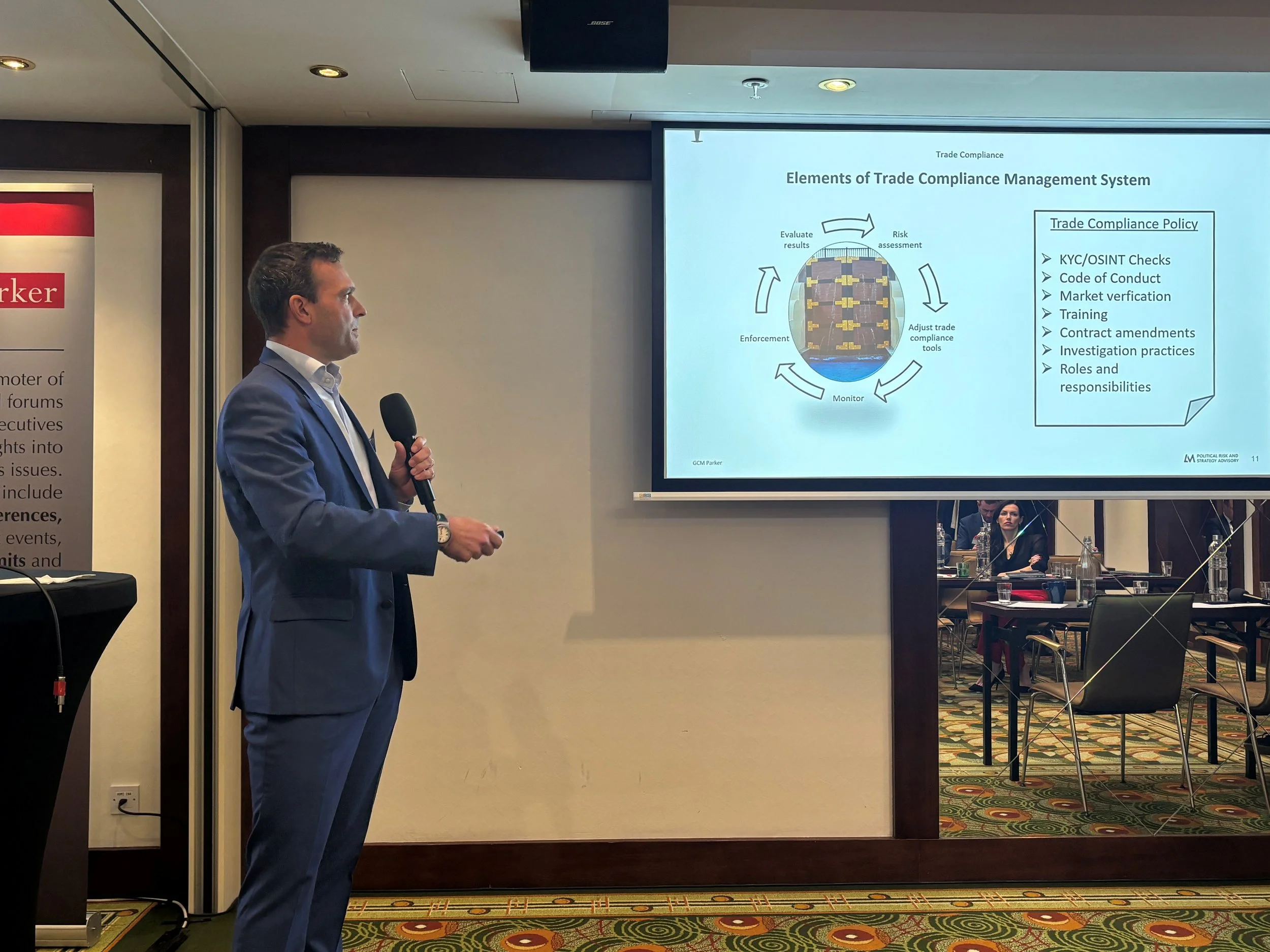
Dr. Johannes Leitner explains the mandatory pillars of a modern trade compliance system
NTV podcast by Kevin Schulte with Managing Partner Dr. Hannes Meissner
A sudden traffic jam stretching for miles at the border between Kazakhstan and Russia has brought freight traffic between the two countries to a standstill for months. Customs officials on the Kazakh and Russian sides are checking deliveries very carefully. Experts discuss the geopolitical reasons for this.
The Oral-Samara highway is an important hub for freight transport between the two countries, which are members of the Eurasian Economic Union. The importance of the transport corridor has increased since the start of the war in Ukraine, as goods that can no longer be delivered to Russia directly are being transported via Kazakhstan.
“There are conflicting interpretations of the reasons for the blockade, underscoring the geopolitical significance of this incident”, says Dr. Hannes Meissner. While Moscow argues that Russia had to close the border for security reasons, some Western experts believe that this incident represents a serious move by Kazakhstan away from Russia and toward the West.
In the NTV podcast, managing partner Dr. Hannes Meissner argues that Kazakhstan has always tried to strike a balance between Russia, China, and the West. On the one hand, its Soviet past means it is heavily dependent on Russia. On the other hand, it seeks cooperation with China and the West. Therefore, the blockade is more of a symbolic act than a new reality that would mean better compliance with Western sanctions against Russia. Kazakhstan wants to demonstrate its sovereignty to Russia while presenting itself to the West as a reliable partner. This is entirely in line with its traditional policy of balancing between both sides.
Please follow the link to the NTV Podcast.
Expert contributions by Dr Hannes Meissner and Dr Johannes Leitner at the Economic Council at Moody's, Frankfurt/Main
The high-profile network International Circle of the Economic Council of Hessen (Wirtschaftsrat Hessen) is a meeting place for entrepreneurs, politicians and experts to discuss the hottest topics relevant for businesses. In October 2025, the event ‘Pressure Points: Sanctions, Sovereignty and the New Geopolitical Order’ brought together experts and practitioners to discuss the role sanctions play in shaping sovereignty, power and the emerging global order.
In his keynote speech, Managing Partner Dr Hannes Meissner spoke about the new geopolitical realities and sanctions as a foreign policy instrument that dominates global business relations. To meet new minimum standards of trade compliance, companies must evolve their traditional export control systems into an integrated and centralized trade compliance management system. Investigation software programs and comprehensive, in-depth analysis by experts are indispensable today.
The practical workshop entitled ‘Sanctions in the shadows: Mastering geopolitical risks and increasing sanction complexity’, led by Dr Johannes Leitner, Managing Partner, LM Political Risk and Strategy Advisory, and Hera Smith, Director and Practice Lead for Financial Crime Compliance at Moody's, focused on identifying key risk areas, analyzing current developments and sharing experiences on strategies for dealing with uncertainty.
The presentation slides can be found at this link.
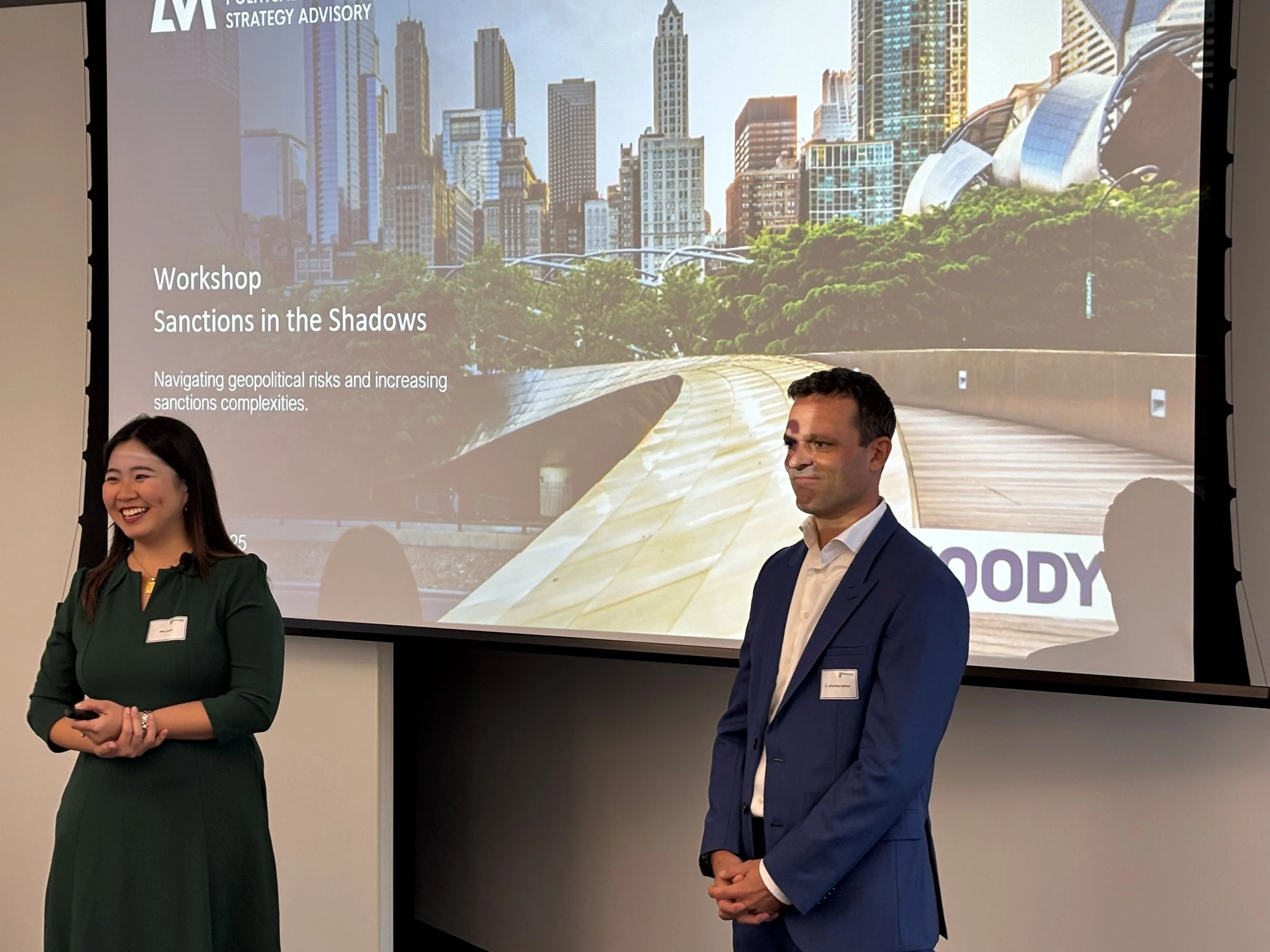
Hera Smith (Moody´s) and Dr. Johannes Leitner (LM PRISK)
Publication by Dr Johannes Leitner and Dr Hannes Meissner in ‘Compliance Praxis’
One of the largest trade hubs worldwide is the UAE (United Arab Emirates) – a centre of global trade. Companies benefit from excellent infrastructure and business-friendly conditions. However, this is offset by enormous trade compliance risks posed by the black box that is the Jebel Ali Free Zone, which must be managed. An analysis of this can be found in the September issue of the magazine ‘Compliance Praxis’.
Expert input from Dr Johannes Leitner at the "Ost-Auschuss der Deutschen Wirtschaft"
The format of the “Ost-Ausschuss der Deutschen Wirtschaft" is aimed directly at companies in Russia and Germany and is primarily intended to facilitate the exchange of experiences, practical ways of dealing with the situation and to provide greater clarity and certainty. The September edition focused in particular on the effects of the European Union's 18th package of sanctions, tax and legal adjustments in the Russian Federation, and the possible impact of the changed political situation on companies.
Key takeaways included:
While Russia's budget is constrained by decreasing oil and gas revenues, those industries profiting from the war economy are still doing well.
However, public spending will need to be managed more stringently than in the past years.
Military and security expenditures will remain high.
Sanctions do have an impact on Russia's economic performance.
The slides from the presentation can be found at the following link.
Presentation by Dr. Johannes Leitner at the Vienna Stock Exchange’s “Digital Capital Market Update”
The Vienna Stock Exchange's (Wiener Börse AG) digital capital market updates provide regular information on news from the Vienna Stock Exchange and highlight market developments with selected capital market experts. In the September edition, Alois Wögerbauer, Managing Director of 3 Banken-Generali Invest, shared his analysis of the global and domestic economy and the stock markets. Managing Partner Dr. Johannes Leitner then reported on how geopolitical risks should be taken into account as new variables in the corporate context and what strategic adjustments this entails for companies. The session was moderated by Henriette Lininger (Wiener Börse AG).
Key takeaways were:
1. Geopolitical risks are a new variable in corporate management
2. Political interventions in global trade are on the rise
3. Globalization is being replaced by political objectives
4. An integrative approach is necessary for corporate management
The slides from the presentation can be found at this link.

Henriette Lininger (Wiener Börse AG), Alois Wögerbauer (3 Banken-Generali Invest), Johannes Leitner (L&M PRISK)
“Profil” Interview with Dr. Hannes Meissner
Managing Partner Dr. Hannes Meissner gave an interview to the Austrian newspaper "Profil" on the Russian strategy behind the Russian drone incursion into Poland. The incident proofs that real peace negotiations on Ukraine are out of reach. Russia insists on its maximum goals, which are the same as before the war in 2022. In Moscow's eyes, Ukraine's sole integration into a Russian dominated security block is non-negotiable. While Europe is discussing peace oppourtunities and ReBuild Ukraine, the drone incursion into Poland shall re-emphasize this claim and threaten Western states and societies. It shall remind them that the price of supporting Ukraine is high, as the ongoing war entails the risk of a direct war between NATO and Russia. This is the link to the newspaper article.
Geopolitical Risks and Market Entry Decisions
Given the tectonic shifts we are currently experiencing in politics, economics and business on a global scale, we need a new generation of decision-makers who are able to understand and manage these developments and their consequences. Against this backdrop, Dr Johannes Leitner was invited to share L&M PRISK's insights and experiences with the students of this year's CEMS (The Global Alliance in Management Education) group at the Rotterdam School of Management, Erasmus University.
The guest lecture focused on geopolitics and economic fragmentation, the impact of geopolitical risks on businesses, and the importance of the corporate perspective in assessing the risk context. In addition, the students discussed a real-life case study to apply all these aspects. The presentation slides can be found at this link.
(Geo-)political Risks require an adequate Trade Compliance System
Dubai is one of the world's most important trading centres. Goods from all over the world are shipped via Dubai to destinations around the globe. For many companies, Dubai is the ideal location for distributing their products.
The risk posed by the region's trading centre lies in the lack of transparency along the distribution chain. Companies can lose track of where their products ultimately end up. Another particular risk is the country's geographical proximity to Iran. From a trade compliance perspective, this is indeed a nightmare.
L&M PRISK's task was to take a close look at the processes on site, uncover sanctions circumvention practices, and establish a functioning trade compliance system at company level.

Photo: L&M PRISK
Authors of The Routledge Handbook of Political Risk establish Academic Institution
The Political Risk Studies Association (PRSA) serves as a space to promote networking and scientific/academic exchange among researchers, students, companies, consultants, and any individuals interested in the topic of political risk analysis and management.
The Association will maintain a digital platform to foster open conversation, exchange of ideas, updates, publications, and discussion of a variety of aspects of political risk analysis for both experts and individuals interested in the topic. It will also provide information on seminars and webinars, conferences or workshops on the topic of political risk. We plan to host one in-person event per year, with the first taking place in spring 2026.
Membership is free. If you are passionate about political risk, come and join in the conversation.
LM PRISK Partnership with LexisNexis
As of July 1, 2025, L&M PRISK is the exclusive partner for trade compliance of the Compliance Network Austria. The network aims to professionalize and anchor compliance in Austrian companies. Information, further training and the transfer of experience and knowledge are the focus of all network activities. The heart of the network is the platform www.compliance-praxis.at, which provides daily updates on innovations and trends and invites active networking. LM PRISK will contribute its expertise on the current and highly relevant topic of trade compliance management. With a focus on geopolitical framework conditions, investigative insights and best-practice know-how on the latest standards of trade compliance requirements, LM PRISK stands for methodical competence and innovative solutions.
Assessment of geopolitical shifts and security challenges in the Black Sea region
On June 18, 2025, the Austrian Institute for European and Security Policy (AIES), in cooperation with the Federal Ministry of Defence, hosted an expert workshop that addressed recent developments in the Black Sea region and provided in-depth country-specific perspectives on Georgia, Bulgaria, Turkey, Romania, Ukraine and Russia. The focus was on the ongoing war in Ukraine and its far-reaching regional impact. As Johannes Leitner pointed out, hybrid warfare has a direct negative impact on economic and business security and requires a policy that takes into account the full spectrum of national security.
“Doing Business in Ukraine” conference in Berlin and German-Uzbek Economic Council in Duesseldorf
During the “Doing Business in Ukraine” conference, organized by the “Ostausschuss der deutschen Wirrtschaft” on June 11th 2025, Johannes Leitner discussed with business representatives current opportunities and challenges for companies in Ukraine. There are numerous high-level initiatives that aim at paving the way for more investments in Ukraine, among others the Business Advisory Council which prepares recommendations and concrete projects to support Ukraine’s business environment.
The German-Uzbek Business Council, which took place in Düsseldorf on June 20, aimed to discuss current and potential future business projects in Uzbekistan. Given the dynamic society, promising economic development and improving political conditions, the country is a promising destination. However, knowledge of the cultural and business peculiarities is a must. For this reason, Hannes Meissner and Johannes Leitner took part in various personal discussions and shared their insights and knowledge.
Webinar of Paris based ESCP Geopolitics Institue
In a world increasingly shaped by geopolitical uncertainty, the webinar delved into how businesses can assess and respond to political risks. From pandemics and nationalism to climate change, technological disruption, and war, the discussion explored the evolving threats facing global enterprises. Hosted by Maxime Lefebvre and Vanessa Strauss-Kahn, this special session brought together three of the four editors of the Routledge Handbook of Political Risk to examine both the theory and the real-world implications of political risk for decision-makers. While Cecilia Sottilotta focused on theoretical-conceptual questions, Julian Campisi focused on managerical questions. Hannes Meissner contributed his expertise from a consulting perspective. This in-depth conversation is a must-watch for professionals, academics, and students seeking to understand how political risk intersects with global business strategy. To watch it, please follow this link to Youtube.

Mutual Benefits for Customers in the Course of Rebuild Ukraine programmm
On June 27, Johannes Leitner and Hannes Meissner met with Igor Basanskyi in Bratislava to sign a partnership agreement between L&M PRISK and Itera. The Norwegian company has a strong presence in Scandinavia, Central and Eastern Europe and Ukraine and focuses on digital business, data, AI, analytics and cloud services. They are part of the “Rebuild Ukraine” program, supporting companies entering Ukraine. In this context, Itera uses its extensive local network of politicians, international organizations and suppliers and supports foreign companies in identifying, developing and implementing new business opportunities in Ukraine. Here, too, they combine business and digital agendas. L&M PRISK supports with valuable expertise in political risk management, screening, monitoring and analysis of the political and market environment as well as the development of customized solutions. A key asset is L&M PRISK's corporate intelligence networks in the region, which provide in-depth and highly specific answers to investors' pressing questions about KYC, the market and the political environment. As a first step, Itera and L&M PRISK prepare join events in Vienna and Bratislava in autumn.

From left to right: Hannes Meissner (LM PRISK), Igor Basanskyi (Itera), Johannes Leitner (LM PRISK)
Presentation by Johannes Leitner at the “Ostausschuss der Deutschen Wirtschaft”
Johannes Leitner from LM Political Risk and Strategy Advisory was invited by the “Ostausschuss der Deutschen Wirtschaft” to give an update on the current situation in Russia. The online format “Current Situation in Russia” was held on April 1, 2025. Johannes Leitner presented the following conclusions: The peace negotiations with Ukraine will not come to a conclusion, the sanctions by the USA will not be tightened for the time being, but they will not be lifted either, and the EU will adopt further sanctions packages. Russia itself is currently writing new rules of the game for Western companies that are interested in re-entering the market once the war and sanctions have ended. It must also be clear that the market in Russia itself has changed. For more information, please see the slides.
New article by Johannes Leitner, Hannes Meissner and Matthijs Verheijen in the Journal "Compliance Praxis"
As peace approaches, the sanctions against Russia will be lifted. As nice as this assumption may sound, it is currently unlikely. The USA has not lifted a single sanction under Trump and the EU remains convinced that sanctions will continue. An end to the conflict is a long way off. This is the link to the full article (behind a pay-wall).
Public Event with Johannes Leitner and Hannes Meissner at the Austrian Institute of International Politics (OIIP)
The “Routledge Handbook of Political Risk” has recently been published by Taylor and Francis. The book that consists of 33 chapters has furthermore been edited by Cecilia Emma Sottilotta and Julian Campisi. It explores the context, analysis, and management of political risks arising from recent tectonic geopolitical challenges posed to the world order by pandemics, nationalist policy interventions, changing supply chains, technological transformation, and the climate ctrisis. The public event at the OIIP titled "Political Risks, Threats and Opportunities in a Changing World – Assessing the Business Context" was moderated by Cengiz Günay (Director OIIP). Another panelists was Zeynep Arkan (OIIP/Hacettepe University, Ankara). The book presentation was followed by a discussion based on questions and comments from the audience, focusing on two main topics: Firstly, poltical risks characteristic of emerging countries, and secondly, supply chain interruptions. In the latter regard, Andreas Tengler (Tengler Consulting) concluded: „In order to counter both geopolitical and national disruptions, companies today have great opportunities to adapt their supply chain as quickly as possible with big data, AI and integrated planning. Unfortunately, however, most companies are not yet well enough positioned in terms of processes, organisation and data quality.” With this statement, he underlined the key message of the event: political risks must be managed.

From left to right: Cengiz Günay, Zeynep Arkan, Johannes Leitner, Hannes Meissner
Hannes Meissner as Speaker at Workshop with Managers, Experts, and Researchers at University of Zurich
How can companies in Ukraine track geopolitical risks and navigate them? This question was explored in an invitation-only workshop, jointly organized by the European Business Association (EBA) and the University of Zurich. The event brought together business leaders operating in the region with experts and researchers working on the topic for an action-oriented workshop on how to navigate geopolitical risks related to the war in Ukraine. In their invitation to the workshop, the University of Zurich and EBA highlighted that the war in Ukraine has accelerated deglobalization and the move toward a multipolar economy beyond the old West-East divide. Companies operating in the region must stay highly aware of political developments. Markets are shaped by politics – through supply chain regulations, trade barriers, and conflicts. In his speech, Hannes Meissner introduced human intelligence (HUMINT) and open-source (OSINT) methods of how to investigate and analyse geopolitical risks. He furthermore addressed latest geopolitical risk management strategies, inter alia cuttinge-edge trade compliance approaches, scenario-analysis, and geopolitial risk impact assessment models. Concering Ukriane, he drew the conclusion that companies need a realistic picture of chances and geopolitical risks that can be managed though. Although a peace-agreement is unlikely and state capture remains a major risk, the country offers promising opportunties for European enterprises.
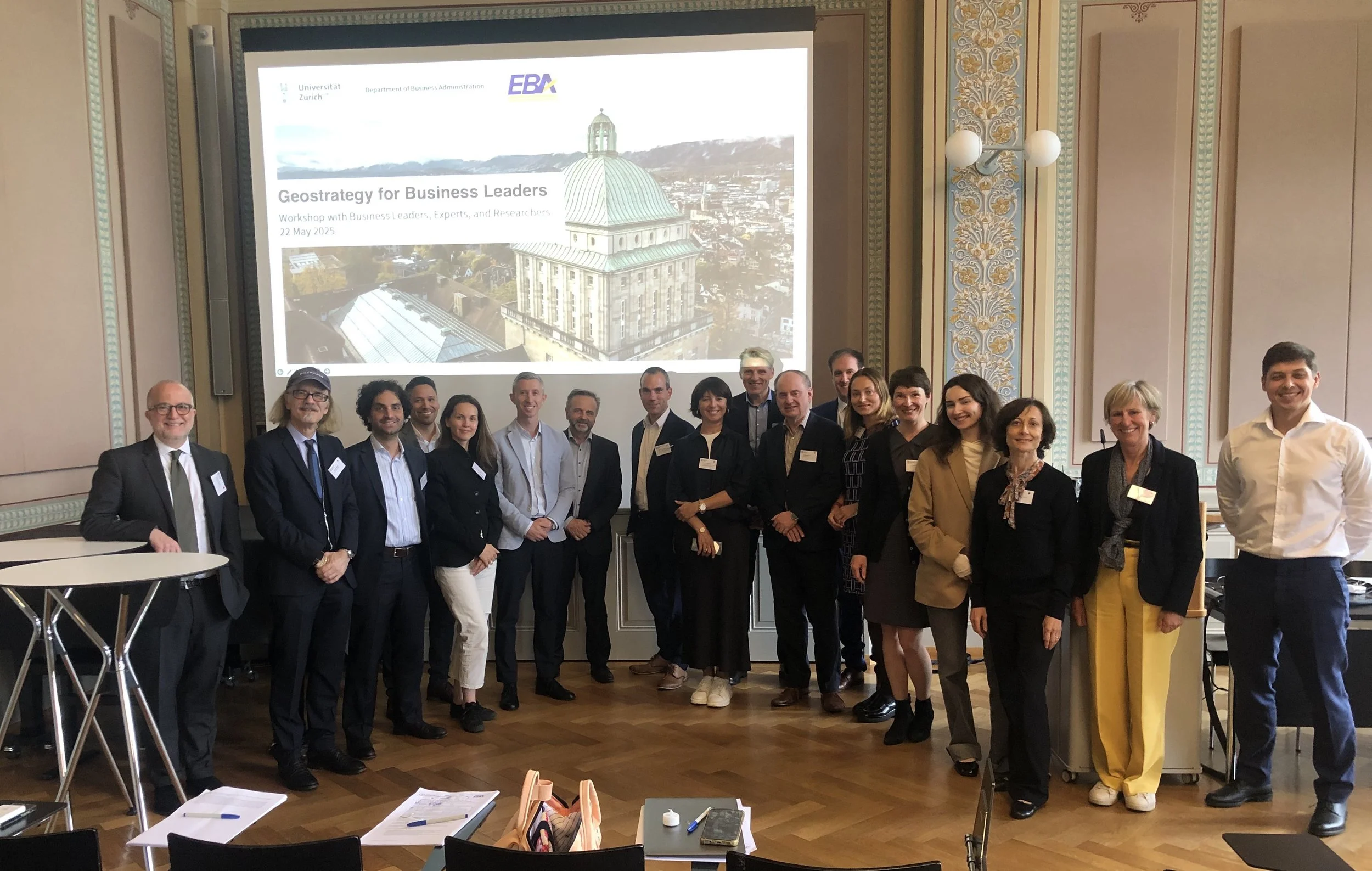
The group of speakers and participants.